

Making Time for Instructional Leadership
June 15, 2026
Start Here
June 15, 2026
Rabbi Sharir Yablonsky
In all schools, including ours, a great deal of meaningful learning takes place every single day. Rebbeim and teachers are teaching, students are working, and as school leadership, we are supporting. Yet even with all that activity, we often found it difficult to see clearly what is actually happening across the school in real time in a way that is meaningful in the present and helpful for moving forward into the future.
Parents did not always know what would be covered that week or what would come next. Administrators often relied on snapshots, quick classroom visits, hallway conversations, or bits of data. Even teachers moved from lesson to lesson without always having the opportunity to step back and reflect on what worked and what did not. The issue has never been a lack of effort or commitment. Instead, it came down to the absence of a simple, consistent way to capture what is already happening and make it clear and useful for everyone.
We’ve since implemented a schoolwide system so that information is consistently available. Parents receive a clear weekly update, emailed and posted, so they can see what was learned and what is coming next. Now, when parents share that they don’t know what their child is learning, we gently ask them whether they have had a chance to review the weekly report. The clarity is there when it is accessed. Perhaps most significantly, the weekly reporting system has pushed us, as school leaders, to consider how we share information with parents. It is not only about providing the report but also about helping parents recognize its value as a tool for staying connected to their child’s learning.
The Weekly Reporting System
At its core, the system is simple. Each week, every teacher fills out a short, structured form. From that single form, a clear parent update is generated, school leadership gains a real-time view of what is happening, and teachers build a running record of their own work. This entire system is built using Google Forms and Google Sheets, tools most schools already have access to, so there is no added cost. There is no need for outside platforms or expensive systems. It is simple, accessible, and easy to maintain.
Each teacher fills out one short Google Form at the end of the week. The form captures content (what was taught), skills (what the students can do), homework and upcoming assessments, students who deserve recognition, concerns or red flags, and parent communication. The responses automatically feed into a Google Sheet. From there, a weekly parent digest is generated, administration can view a live dashboard, and teachers build an ongoing record they can look back on.
Perhaps the main objective of this system was to improve communication with parents. Instead of scattered updates, parents now receive a clear weekly digest. They know what was learned, what is coming up, what homework looked like, and which students were recognized. This allows them to be more connected and more helpful at home.
However, the weekly reporting system has also been transformative for teachers and principals.
The Teacher Experience
What has made this system meaningful is not only its simple structure, but how teachers are experiencing it. Teachers have shared that they are not simply filling it out at the end of the week. It is guiding them from the beginning. As the week starts, they are already thinking about what they plan to teach. Then, at the end of the week, they return to the form and respond based on what actually happened.
Because it is done every week, it creates a steady rhythm. Teaching is reviewed. Students are reviewed. That shift matters. Nothing sits too long without being noticed. Reflection is no longer something extra; it becomes part of the normal flow of teaching. We heard a great deal of feedback like this. While it is true that for some it initially felt like extra work, across the team it has come to be appreciated. For those interested in growing, both individually and as part of a staff, there is a clear sense that this year’s outcomes have made it worthwhile.
When teachers heard that I was writing about the Weekly Report, a number of them immediately requested, “Please make sure you share how easy it is to input the info.” Some even suggested including a screenshot so others could see it for themselves. It is straightforward and clear, and it does not feel overwhelming.
Here is some feedback from teachers:
“It’s actually easier than I expected. Once you do it a couple of times, it just flows.”
“It helps me plan my week before it even starts.”
“By the end of the week, I already know what I’m going to write; it’s not a scramble.”
“The format makes it clear. You’re not guessing what to include.”
“The flagging really helped us see what’s going on with certain students across classes.”
“It keeps the conversation going between teachers. You’re not alone with what you’re seeing.”
“At first it felt like one more thing, but now I see why we’re doing it.”
The form itself asks teachers to think about both content and skills—not just what was taught, but what students were actually doing: reading, analyzing, explaining, and solving. It is a small distinction, but, over time, it helps teachers see their teaching more clearly. Teachers also log homework and upcoming assessments and highlight students who stood out, whether in effort, behavior, or participation. That last piece has been especially important, as it shifts part of the focus toward what is going well, not only what needs attention.
At the same time, there is space to flag concerns, academic, behavioral, or otherwise. This has been one of the most impactful additions this year. The flagging system has helped sustain conversations even after the reports are submitted. Instead of teachers working in isolation, there is now a clearer, shared understanding of what certain students are experiencing across classes. Teachers are communicating more with each other, and patterns are being noticed earlier.
The Principal’s Experience
For us, as school leadership, the system has provided a much clearer picture as well. Rather than relying on impressions, we now have real information to work with: what is being taught, where students are struggling, and how communication is happening across the school.
At the same time, it has pushed us to rethink our own role in this process. Putting the system in place was not enough. These reports have little impact if they are collected and filed away. They need to be read and, more importantly, discussed. That takes time, and it is not always easy to make space for it. But when we do sit down together and go through a report, that is when it becomes meaningful, not as a document, but as a starting point for real conversation.
We have had to adjust. Less time spent setting things up, and more time spent actually engaging with teachers, looking at what they are seeing, asking questions, and thinking together about what comes next.
What Has Changed
It is still a work in progress. Not every teacher connects to it right away. For some, it can feel like one more task. That is real, and it continues to push us to refine the system so that it remains clear and manageable. Even with that, there has been a noticeable shift. Over time, something more valuable has begun to develop.
Teachers themselves are looking back. They compare weeks. They notice patterns. They think differently about pacing, balance, and student responses. What began as a reporting system has become something more. It has become a simple, consistent way to build reflection into the week, not in a heavy or forced way, but in a way that fits naturally into what teachers are already doing.
This system is not about adding more; it is about making what already exists clearer, more connected, and more useful. The goal is not perfection. It is a steady movement—small, consistent steps that build over time. And when that happens across an entire school, the impact is real, for teachers, for students, and for the school as a whole.
Rabbi Sharir Yablonsky is the menahel of Rabbi Jacob Joseph/Merkaz HaTorah in Staten Island, known for his commitment to student growth, strong leadership, and innovative educational programs. Contact him at rabbiyablonsky@ymht.org.
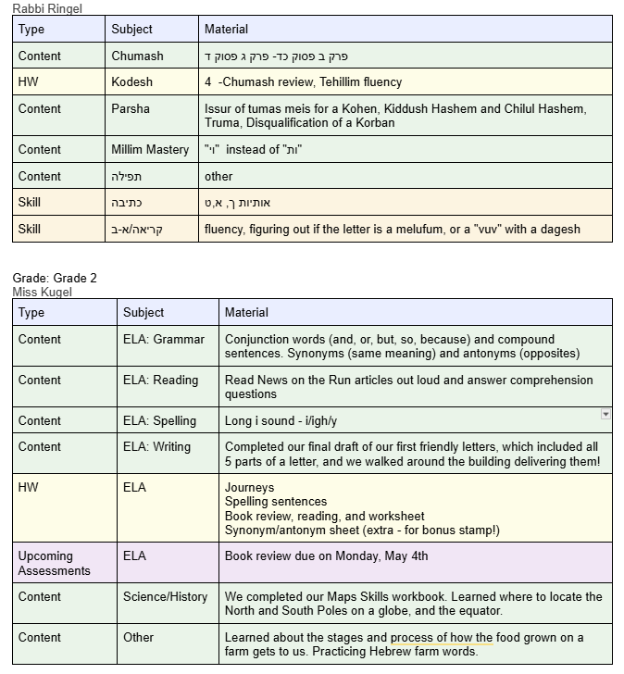
Figure 1. This is a sample of what parents see in the weekly report.
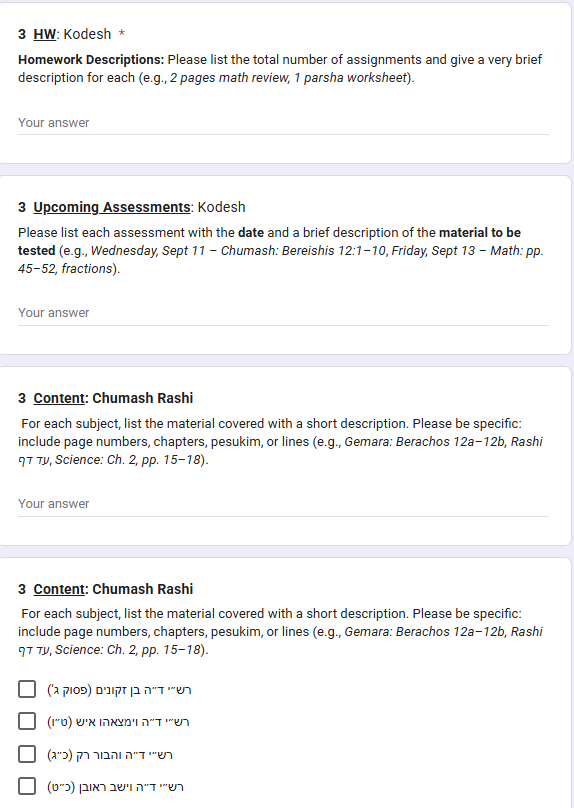
Figure 2. This is a sample of what a teacher would see to enter the information each week.