
We’ve Come So Far … Where Do We Go Next?
February 20, 2026
More Than Words: How Kriah Comes Alive in Our Yeshiva
February 20, 2026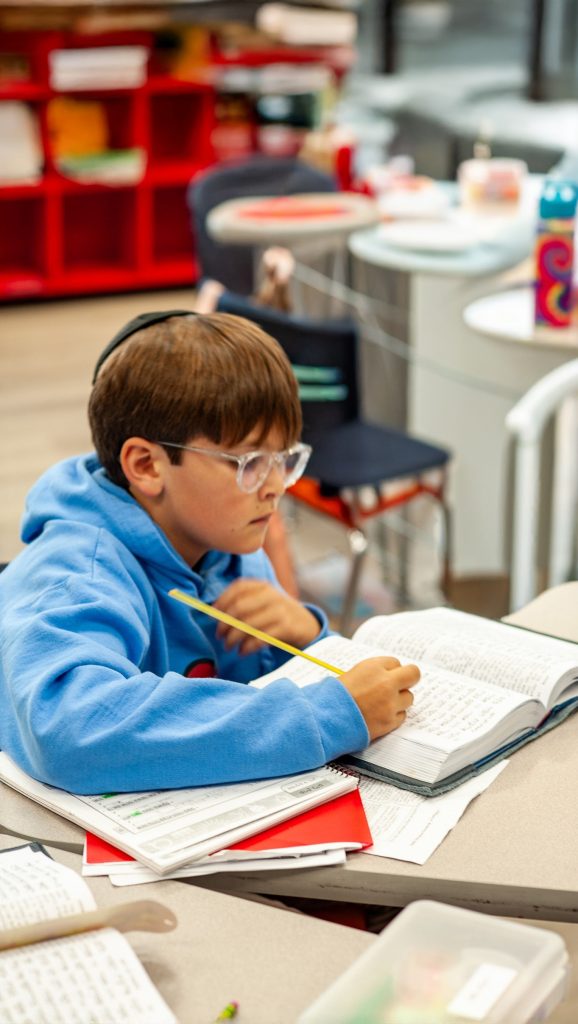
Rabbi Avichai Pepper
Success for any student in most subjects includes the critical ability to read. In the younger grades, kriah is its own subject, and teachers invest significant time helping students improve their reading skills. However, once a boy begins learning Gemara, reading practice often goes out the window. I have often compared this step in the educational process to dropping someone off a cliff and hoping the few skills and bits of equipment they have will help them land safely.
In the younger grades, reading focuses on simple words with nekudos and plenty of support. By mid-elementary, practice decreases and assessments are rare, leaving struggling readers to continue struggling while stronger students move ahead. When Gemara learning begins, the changes are dramatic, including a new language, unfamiliar layout, lack of grammatical instruction, and no nekudos. A student already struggling with reading is not set up for success. Middle elementary classrooms often rely heavily on students’ memorization skills and developing critical thinking, while assuming they can read. Upper grades, such as high school, carry an unspoken expectation of reading fluency that is rarely realistic and seldomly verified.
Student-Centered Learning
A simple way to encourage more reading and better use of classroom resources is to shift from frontal teaching to student-centered learning. Student-centered learning is an approach that moves the teacher from the front of the classroom as a lecturer to an architect who develops a space for students to own their learning. In a student-centered classroom, the teacher can move around, work with weaker students, and support their growth rather than lecturing from the front. This model allows students to progress at their own pace while improving reading accuracy. This method is designed for mainstream classrooms allowing teachers to focus on individuals and the class as a whole.
Here is a description of a student-centered classroom: Before teaching the next lines of text (Chumash, Mishna, Gemara, or any other text), the teacher shares the background and any unusual words with the students. Then, in small groups, the students work to decode the words and attempt to read, translate, and explain the text’s ideas to each other. While this is happening, the teacher is free to move around the classroom to support or guide students who might need help. Since the teacher is no longer at the podium, a weaker student can receive personalized help with reading and understanding.
I recently had the opportunity to develop a curriculum unit for a class of 12th-grade boys who have struggled to find success in their learning. Rather than forcing them to stare blankly at a Gemara, I restructured the class, trying to meet them at their skill level while still engaging in meaningful learning. The unit focused on Megillas Esther. The boys spent a few days reading and translating pesukim and Rashi from the megillah. After mastering those skills, they were given a page from the Gemara (with nekudos) that discussed the pesukim they had learned. As before, they spent time working to fill in translations of words rather than listening to their rebbi read to them and tell them what the text says and means. After a week of learning this way, one of the boys commented to me, “I learned more this week than I have in the past twelve years combined.”
This student-centered unit created a bridge between their skills and the challenging material. As students worked at their own pace, each boy focused on the skills he needed to improve. It helped that the Purim story provided an engaging topic of study. Although it was hard work, the boys approached learning this sugya from a perspective that was reading-and translating-first, starting with the basics and proceeding to the more intellectually challenging aspects. They successfully learned and built skills in being able to learn תנ”ך, תורה שבעל פה, and the ראשונים.
Such a model can be deployed easily in middle school. Unit by unit, rebbeim can focus the students on starting with the fundamentals, developing their reading skills before diving into a deeper understanding of Gemara, למדות, and סברא.
Our long-term goal is to create lifelong learners. Everyone is familiar with the concept of individualized education based on the pasuk in Mishlei, חנוך לנער על פי דרכו, yet we rarely focus on the next words: גם כי יזקין לא יסור ממנה. The true goal of individualized learning is that as our students grow, they become and remain capable and motivated lifelong learners. By adopting a student-centered approach and empowering students to strengthen their skills at every grade level, we can nurture lifelong learners.
Rabbi Dr. Avichai Pepper is a seasoned educator with a rich academic and professional background. A graduate of the New England Rabbinical College in Providence, RI, he has devoted his life to teaching Torah and to Jewish communal growth. Rabbi Pepper holds a Doctorate in Educational Leadership from Liberty University, alongside a master’s degree in educational leadership from Bellevue University and a master’s degree in counseling from Liberty University. Currently serving as the Director of Educational Advancement and Community Relations at the Yeshiva of Greater Washington, Rabbi Dr. Pepper leverages almost 30 years of dedicated service in Jewish education and community development.