
The Mesorah Approach of Kamatz-Alef-Ah: Where Torah Meets Science
February 20, 2026Zucker Jewish Academy, Houston, TX
April 21, 2026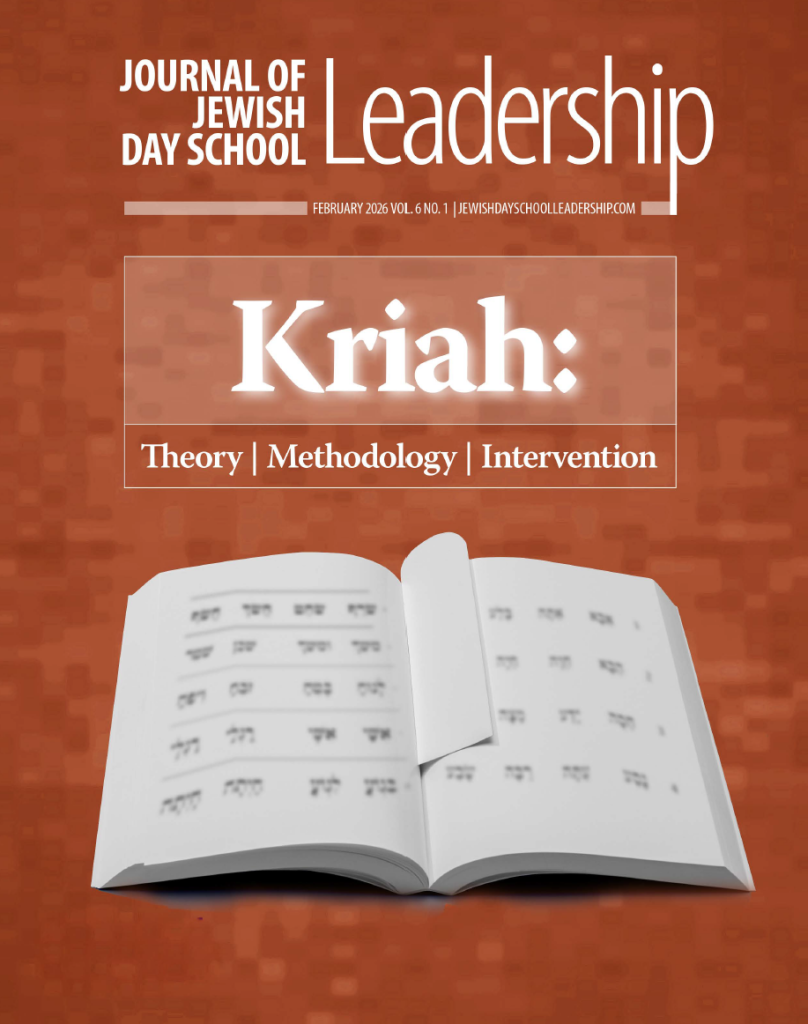
There is perhaps nothing in the Jewish day school curriculum that is more critical for students or more fundamental to what it means to be a Jewish day school than kriah, the skill of reading Hebrew. With kriah, students can access Torah texts and tefillah; without it, they struggle through years of frustration in Jewish educational institutions and leave unprepared to participate fully in Jewish communal and religious life.
Teachers of kriah invest time, energy, and passion in developing curricula, activities, and lessons, and take pride, deservedly, in the role they play in their students’ Jewish education. And yet, the results of formal kriah assessments and the conclusions of many from anecdotal experience indicate that many Jewish day school students aren’t learning to read. This has led to renewed analysis of the kriah programs in many schools, with additional training and the adoption of new programs and materials. Kriah instruction, like much of Jewish education, has some מםורה, a traditional way that it has been done, which makes any discussion of change much more fraught.
Over the last few decades, the educational world beyond the Jewish day school has been roiled by the “Reading Wars,” a major technical and philosophical debate that featured a wholesale change in how children are taught to read, followed by a correction that sparked yet another major change. While the debate still rages, research seems to align with one side, and this “Science of Reading” approach has increasingly become the standard way kids are taught to read in American schools.
In this edition, we focus on the latest ideas in kriah instruction, including research, theory, and current practice. We explore how the Reading Wars and the Science of Reading that has emerged have affected the way kriah is taught. Kriah instruction is analyzed from multiple perspectives, including pedagogy, psychology, mesorah, and educational leadership. We have also included case studies that illustrate successful interventions and innovations.
Mrs. Nechamy Segal shows how modern reading science can be integrated with the “מסורה method” of teaching “Kamatz-Alef-Ah.” Dr. Jon Mitzmacher summarizes the recommendations that emerge from the Science of Reading and shows how they apply to teaching students to read Hebrew. Mrs. Chana Luchins presents a brief history of the Reading Wars and shows how kriah instruction has been affected.
Rabbi Adi Roland is a kriah rebbi with a well-developed approach, and he explains its theoretical underpinnings. Mrs. Chani Karp differentiates between “memory-reading” and reading based on knowledge of the rules of language, and advocates kriah mastery through כתיבה, writing in Hebrew. Rabbi Jordan Blitstein advocates morphological chunking (rather than phonological) for intermediate kriah students.
Rabbi Yoni Gold presents a roadmap for schools implementing a new kriah program. Rabbi Avichai Pepper suggests that student-centered instruction can help support kriah schools at the middle and high school levels. Mrs. Fraidel Shollar’s article serves as a guide for schools looking to select a kriah program.
Mrs. Tzippy Warshaw describes one school’s journey from Whole Language kriah instruction to the Science of Reading. Rabbi Levi Solomon, Mrs. Aphrodite Bakaleynik, Rabbi Moshe Tropper, and Morah Ariella Rosenblatt share the way their school is addressing the kriah challenge. Rabbi Sharir Yablonsky offers his perspective, based on the renewed kriah focus at his school. Mrs. Rivka Varnai describes how her Ivrit B’Ivrit school addressed kriah and a post-COVID slump.
Mrs. Rivka Dear presents a case study of an eighth-grade boy who finally learned to read. Mrs. Chana Wallach looks at the psychological factors that affect teaching and learning kriah. Rabbi Nachman Goldenberg shares the rationale and approach of his after-school kriah initiative.
In our January 2022 edition, we published an article by Rabbi Shmuel Stein titled “The 5 Steps: A Kriah Program for Schools,” which may be helpful for schools or school leaders who are looking to analyze and revitalize their kriah programs.
Rav Sholom Kamenetsky presented a vision of Torah leadership when he addressed school leaders at the summer Think Tank conference several years ago. It is our honor to share his ideas with our readers here.
As always, we hope you find this edition informative, thought-provoking, and enjoyable to read. We appreciate your feedback at